Operating at the Intersection of Scientific Innovation and Regulatory Standards
Scientific innovation
Access to cutting-edge, validated research, and technologies through a broad global network of partners
Regulatory standards
FDA, EMA and industry, compliance + contributors to the development of emerging good practice frameworks
Including ‘Toward Good
Simulation Practice’
(Co-authored with the U.S. FDA)
Make earlier, safer decisions with less time, cost, and risk
De-risk every stage from preclinical to post-approval
Decreased reliance on in vivo studies and early human exposure, consistent with FDA initiatives encouraging alternatives to traditional animal testing.
Time and Cost Saving
Preclinical mAb optimization (end-to-end)
12–30 months;
$15 – 30M
Biosimilarity confirmation
1–2 years;
$10 – 30M
Phase 3 ADC optimization
6–18 months;
$20 – 50M
Long-term MS strategy
3–5 years;
$50 – 150M
Rare disease trials
1–2 years;
$10 – 40M
In-licensing BD RWE + synthetic trials
6–9 months;
$5 – 20M (risk avoidance) RWE + synthetic trials
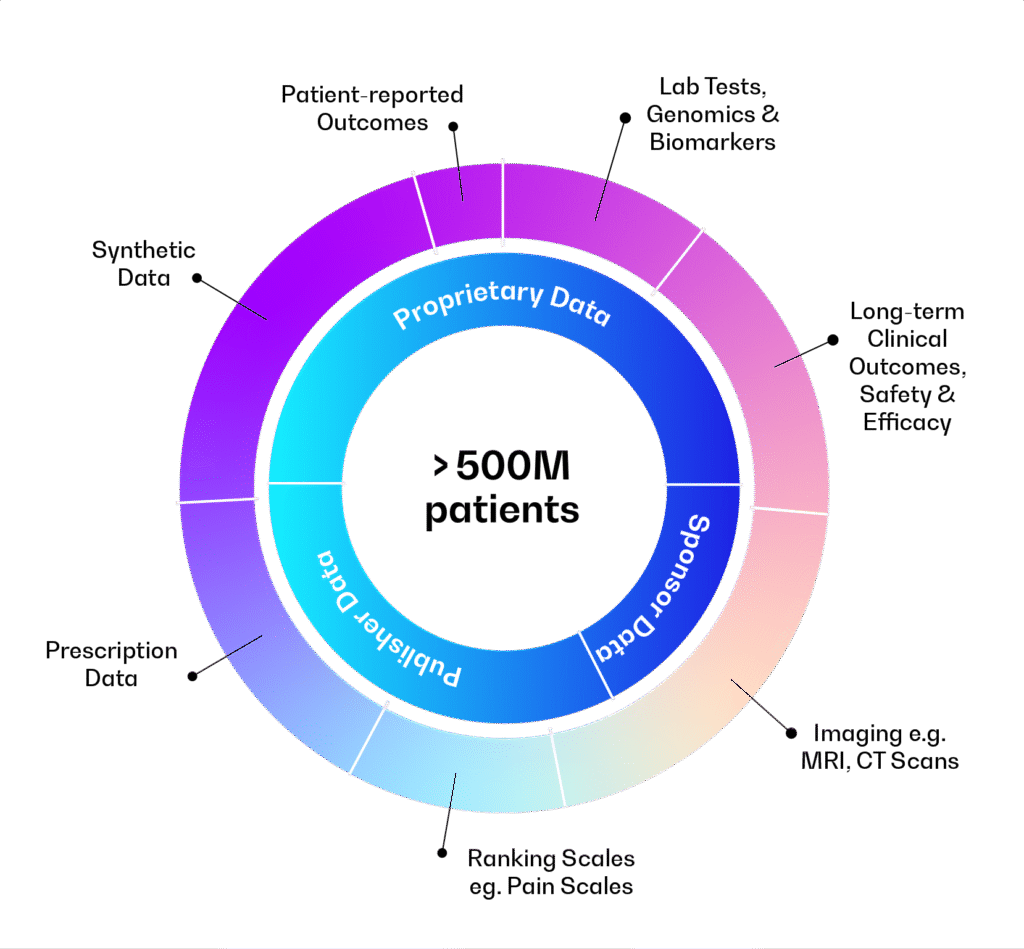
A Unified Data Integration Framework Powering Multi-Modal Data at Global Scale
Subtitle here
Continuous optimisation loop
InSilicoTrials accelerates drug development by integrating mechanistic models, AI, digital twins, synthetic data, and operations forecasting into one platform.
AI support for external information seeking through a multi-agent archite cture that connects tools, internal information, external information, and the simulation platform
Searches external sources (e.g., clinicaltrials.gov) to suggest clinical trial designs
Interprets data, makes recommendations, and analyses simulation results
Independently launches new simulations based on retrieved information and user preferences
A development team needed to optimise a monoclonal antibody’s design and dosing before entering animal studies, reducing wet-lab iteration cycles and early development risk.
Therapeutic Area:
Monoclonal antibody programmes. Preclinical.
Tech:
Mechanistic PK/PD and TMDD modelling, AI-assisted simulation, virtual patients
Savings:
12 – 30 months and $15 – 30M
Approach
AI-assisted Target-Mediated Drug Disposition (TMDD) modelling Simulation of clearance, affinity, and dosing frequency scenarios Virtual patient simulations to predict exposure and target engagement.
Result
Identified an optimised antibody variant with improved affinity, reduced clearance, and stronger target suppression through in-silico experimentation.
Value
Accelerated preclinical optimisation Reduced reliance on in vivo studies Increased confidence before first-in-human studies.
A large pharma organisation needed to optimise the dosing strategy for an antibody – drug conjugate, balancing exposure, tumor control, and thrombocytopenia risk.
Therapeutic Area:
Oncology (ADC). Phase III design.
Tech:
QSP digital twins, PK/PD, tumour growth and safety modelling, PoS simulation
Savings:
6 – 18 months and $2 – 50M
Approach
Multi-scale digital twins linking PK, tumor dynamics, and platelet counts ML and causal comparisons of fixed vs. adaptive dosing Probability of Success (PoS) modeling across virtual populations.
Result
Revealed the optimal weekly regimen with superior efficacy and acceptable safety trade-offs, guiding Phase 3 strategy.
Value
AI-augmented decision-making for pivotal trials Higher PoS and smarter resource allocation Quantified benefit–risk trade-offs before investing in large trials.
QSP modelling of immune response and lymphocyte dynamics Simulation of relapse rates across virtual MS populations Long-horizon (5-year) treatment strategy evaluation.
Result
Identified an optimised antibody variant with improved affinity, reduced clearance, and stronger target suppression through in-silico experimentation.
Value
Evidence to support label extension without new long-term trials Reduced development time and cost Improved understanding of long-term benefit–risk profiles.
We are very delighted to initiate this collaboration with InSilicoTrials and have the opportunity to optimize and accelerate our next clinical steps. Integrating their
industry-leading AI and computational modeling solutions in the development plan of our promising disease-modifying drug will allow us to address the pressing challenges faced by individuals suffering from neurological disorders.
The in silico option can transform trials for which it is difcult to recruit or retain patients, such as with rare or imminently life-threatening diseases, with no or inadequate standard of care Treatments. For clinical trials in small patient populations, in silico models that leverage biological, molecular, or genetic data to characterize the disease can generate synthetic control arms, which, together with Premier Research's expertise in preclinical and clinical development, execution, and regulatory aspects of small population trials, can shrink the time it takes to develop effective rare disease therapies.
Modeling and Simulation (M&S) has become firmly established as a regulatory science priority at FDA during the last decade, coinciding with the enormous expansion of data science and model-based technologies.
We’re honored to have found the perfect partner in InSilicoTrials. RCPE and InSilicoTrials are combining their expertise to help engineers and researchers make data-driven decisions and
deliver new levels of innovation. InSilicoTrials‘ comprehensive simulation platform combined with XPS creates a single-source repository for pharmaceutical development from discovery to dosage form. This collaboration and our shared developmental efforts truly set the gold standard for modeling and simulation in life sciences.
This website uses cookies to improve your experience. We'll assume you're ok with this, but you can opt-out if you wish.AcceptRead More
Privacy & Cookies Policy
Privacy Overview
This website uses cookies to improve your experience while you navigate through the website. Out of these, the cookies that are categorized as necessary are stored on your browser as they are essential for the working of basic functionalities of the website. We also use third-party cookies that help us analyze and understand how you use this website. These cookies will be stored in your browser only with your consent. You also have the option to opt-out of these cookies. But opting out of some of these cookies may affect your browsing experience.
Necessary cookies are absolutely essential for the website to function properly. This category only includes cookies that ensures basic functionalities and security features of the website. These cookies do not store any personal information.
Any cookies that may not be particularly necessary for the website to function and is used specifically to collect user personal data via analytics, ads, other embedded contents are termed as non-necessary cookies. It is mandatory to procure user consent prior to running these cookies on your website.
Registration required
[formidable id=”14″]
Scientific Platform
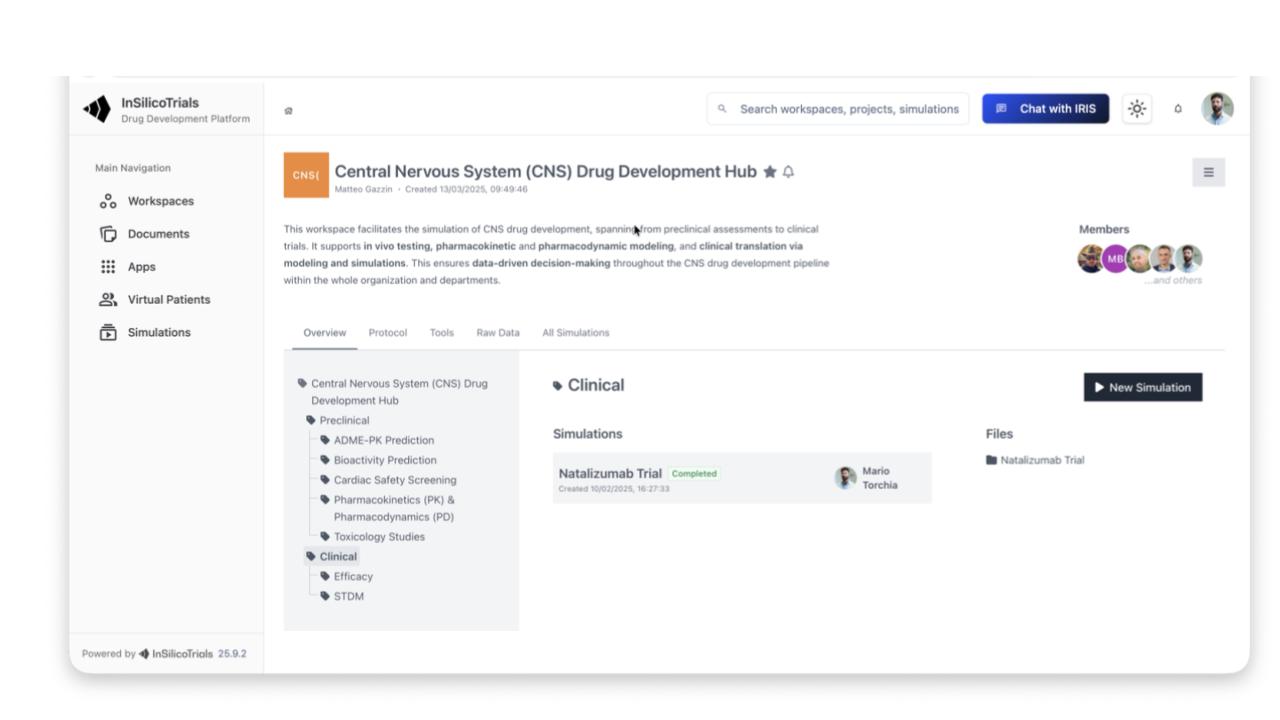
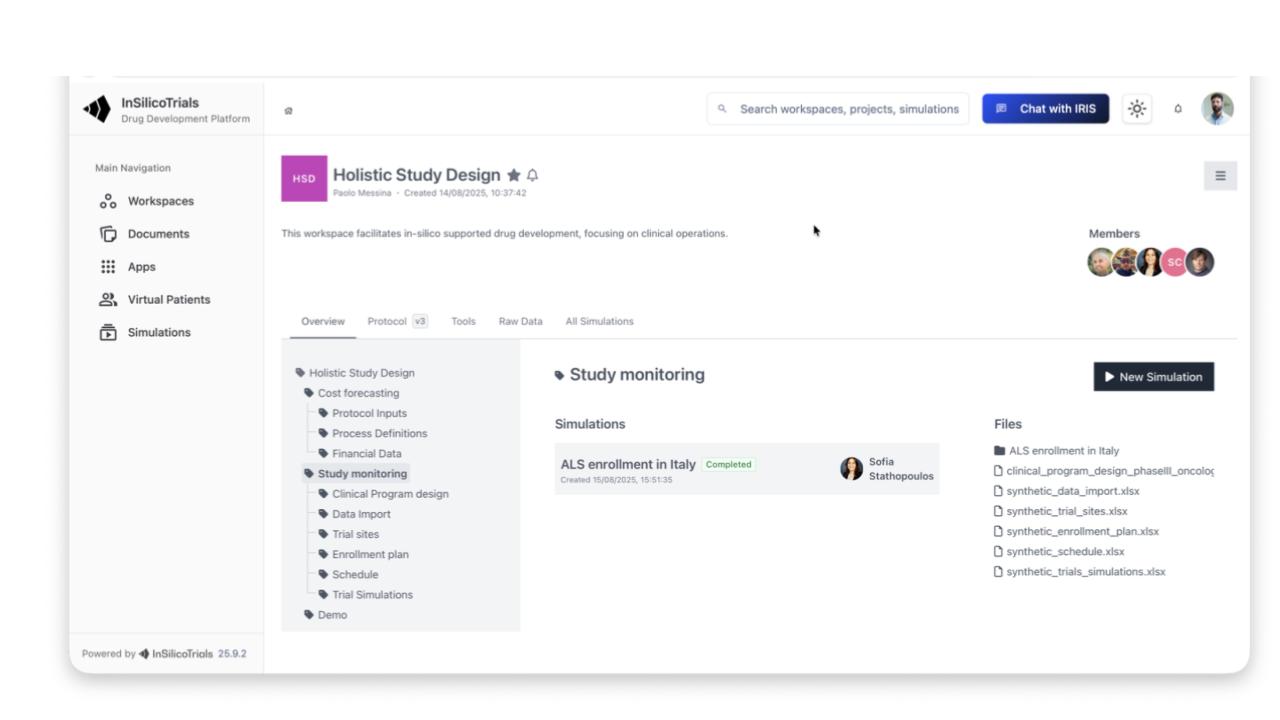
Enables clinical trial simulation, including synthetic patient generation and scenario comparisons: dosing, sample size, I/E criteria, adaptive designs, statistical methods
Includes Model Library, Data Library, data Integrator, Workflow Builder, Clinical Trial Simulator, Output Dashboard
Supports safety, efficacy, biomarkers, disease progression, QSP, multi-omics, in vitro/in vivo, and AI/ML models
Operations Platform
Enables clinical trial simulation, including synthetic patient generation and scenario comparisons: dosing, sample size, I/E criteria, adaptive designs, statistical methods
Includes Model Library, Data Library, data Integrator, Workflow Builder, Clinical Trial Simulator, Output Dashboard
Supports safety, efficacy, biomarkers, disease progression, QSP, multi-omics, in vitro/in vivo, and AI/ML models
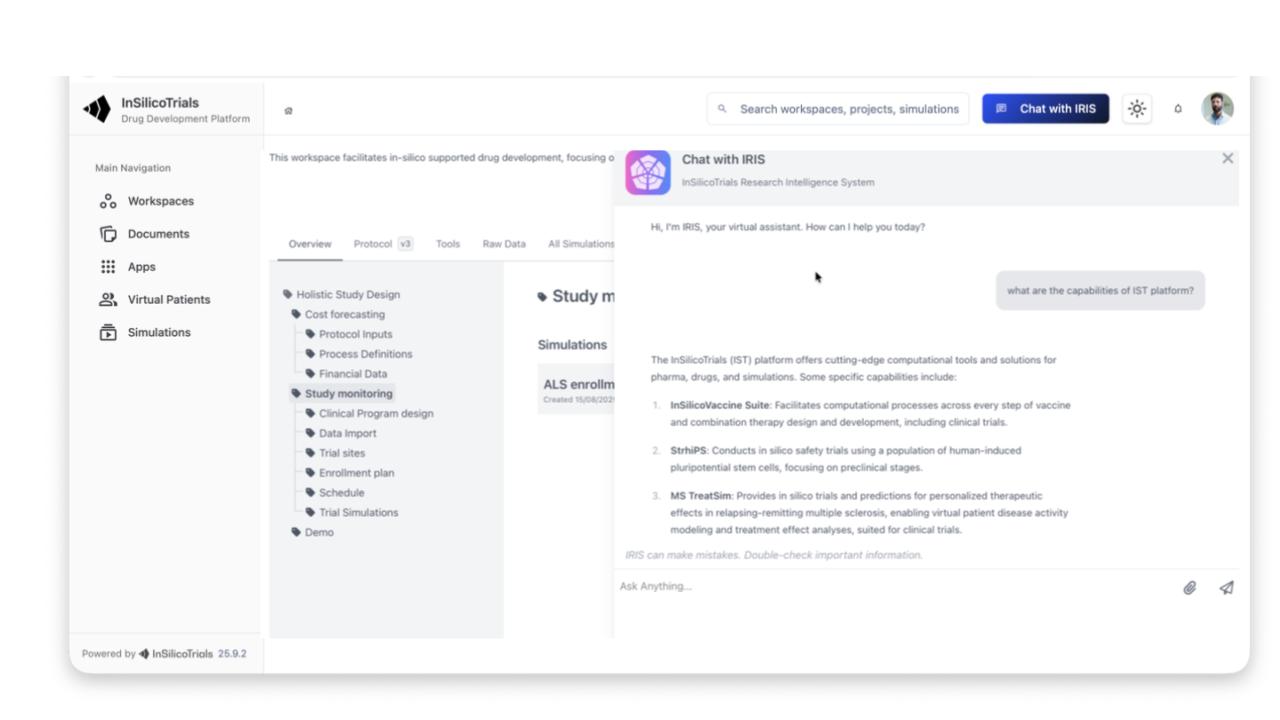
AI support for external information seeking through a multi-agent archite cture that connects tools, internal information, external information, and the simulation platform
Searches external sources (e.g., clinicaltrials.gov) to suggest clinical trial designs
Interprets data, makes recommendations, and analyses simulation results
Independently launches new simulations based on retrieved information and user preferences
In Silico Antibody Optimisation
Challenge
A development team needed to optimise a monoclonal antibody’s design and dosing before entering animal studies, reducing wet-lab iteration cycles and early development risk.
Therapeutic Area:
Monoclonal antibody programmes. Preclinical.
Tech:
Mechanistic PK/PD and TMDD modelling, AI-assisted simulation, virtual patients
Savings:
12 – 30 months and $15 – 30M
Approach
AI-assisted Target-Mediated Drug Disposition (TMDD) modelling Simulation of clearance, affinity, and dosing frequency scenarios Virtual patient simulations to predict exposure and target engagement.
Result
Identified an optimised antibody variant with improved affinity, reduced clearance, and stronger target suppression through in-silico experimentation.
Value
Accelerated preclinical optimisation Reduced reliance on in vivo studies Increased confidence before first-in-human studies.
ALS Synthetic Control Arm
Challenge
Ultra-small patient populations made traditional ALS trial designs underpowered, slow, and ethically challenging.
Therapeutic Area:
Amyotrophic Lateral Sclerosis. Phase II.
Tech:
ML disease-progression models, synthetic control arms, causal inference
Savings:
1 – 2 years and $10 – 40M
Approach
AML-based modelling of ALS disease progression Generation of synthetic control patients Causal inference to enable unbiased treatment comparisons.
Result
Augmented the control arm with 60 synthetic patients, increasing statistical power while reducing the number of patients assigned to placebo.
Value
Improved trial feasibility in rare disease settings Reduced patient burden Faster, more confident go/no-go decisions.
Oncology: Phase 3 ADC Digital twin Optimisation
Challenge
A large pharma organisation needed to optimise the dosing strategy for an antibody – drug conjugate, balancing exposure, tumor control, and thrombocytopenia risk.
Therapeutic Area:
Oncology (ADC). Phase III design.
Tech:
QSP digital twins, PK/PD, tumour growth and safety modelling, PoS simulation
Savings:
6 – 18 months and $2 – 50M
Approach
Multi-scale digital twins linking PK, tumor dynamics, and platelet counts ML and causal comparisons of fixed vs. adaptive dosing Probability of Success (PoS) modeling across virtual populations.
Result
Revealed the optimal weekly regimen with superior efficacy and acceptable safety trade-offs, guiding Phase 3 strategy.
Value
AI-augmented decision-making for pivotal trials Higher PoS and smarter resource allocation Quantified benefit–risk trade-offs before investing in large trials.
MS 5-Year QSP Digital Twin
Challenge
A pharma team needed to evaluate long-term dosing strategies and safety outcomes without conducting multi-year clinical trials.
QSP modelling of immune response and lymphocyte dynamics Simulation of relapse rates across virtual MS populations Long-horizon (5-year) treatment strategy evaluation.
Result
Identified an optimised antibody variant with improved affinity, reduced clearance, and stronger target suppression through in-silico experimentation.
Value
Evidence to support label extension without new long-term trials Reduced development time and cost Improved understanding of long-term benefit–risk profiles.