

Before the First Patient:
How MOL2CLIN Can Help De-Risk Oncology Drug Development in Silico through Microsoft Discovery
Cancer drug development is fundamentally a decision-making problem under uncertainty. Every oncology program begins with thousands of possible molecules, but only a tiny fraction will ever become clinically successful therapies. The earlier teams can identify which compounds are likely to succeed and which are likely to fail, the more efficiently R&D resources can be deployed.
InSilicoTrials is working with Microsoft to help address this challenge by bringing mechanistic simulation capabilities to Microsoft Discovery. Through modules such as MOL2CLIN, InSilicoTrials is enabling oncology teams to evaluate therapeutic hypotheses before entering costly experimental and clinical stages.
Built as an enterprise agentic R&D platform, Microsoft Discovery enables scientists and specialized AI agents to reason, plan, simulate, analyze, and iterate together in continuous scientific workflows. The platform combines agentic orchestration, graph-based scientific knowledge, advanced AI reasoning, and scalable Azure high-performance computing into a unified environment for research and development.
Traditionally, computational methods in oncology have often been used as isolated point solutions, for example predicting binding affinity or optimizing molecular properties.
The key value is earlier de-risking.
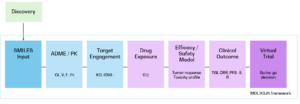
Starting from a molecular structure, MOL2CLIN can simulate how a compound is likely to behave in patients by integrating:
- pharmacokinetics and exposure prediction,
- target engagement modeling,
- tumor growth and response simulation,
- safety and off-target assessment,
- and virtual clinical trial simulation on digital twin of patients
Instead of waiting until animal studies or early clinical trials to understand whether a candidate may have sufficient efficacy or tolerability, teams can evaluate these questions during discovery itself.
That enables scientists to ask:
- Is this compound likely to achieve clinically meaningful exposure?
- Does predicted target occupancy support sustained efficacy?
- How does the projected efficacy compare with current standards of care?
- Are there predicted toxicity liabilities that make the program non-viable?
- Which compounds in a portfolio deserve further experimental investment?
By integrating MOL2CLIN into Microsoft Discovery workflows, these evaluations become part of a scalable scientific reasoning loop rather than isolated simulation exercises. Researchers can continuously refine hypotheses, compare compounds, optimize dose strategies, and prioritize experiments while maintaining human oversight at every critical decision point.
“Microsoft Discovery is transforming how therapeutic candidates are identified and optimized,” said Mario Torchia, CEO, InSilicoTrials. “By integrating InSilicoTrials’ validated drug development workflows into this ecosystem, we will help extend those insights further along the R&D continuum, ultimately allowing researchers to assess clinical potential earlier and make better-informed development decisions. Together, we can help bridge the gap between scientific discovery and patient impact.”
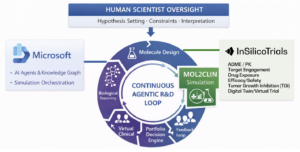
For oncology R&D organizations, this has important practical implications.
Late-stage oncology failures remain extraordinarily expensive, and traditional preclinical models frequently fail to predict human outcomes reliably. Mechanistic in silico approaches calibrated against clinical pharmacology and tumor biology provide an opportunity to shift decision-making earlier in the pipeline, before major investments in toxicology, manufacturing, or clinical trials are made.
“Microsoft Discovery is designed to bring together specialized AI agents, scientific knowledge, and simulation into a unified R&D environment,” said Aseem Datar, Corporate Vice President, Product Innovation for Microsoft Discovery. “We are excited about expanding the platform with capabilities like MOL2CLIN as partners like InSilicoTrials help enable an end-to-end, agentic discovery workflow.”
The workflow presented below illustrates how MOL2CLIN operates within Microsoft Discovery to support that transition. Starting from a candidate molecule (SMILES input), the platform predicts exposure, target engagement, tumor response, safety signals, and simulated clinical outcomes in virtual patient populations.
The objective is not to replace laboratory or clinical research.
The objective is to enter those stages with stronger compounds, better-informed hypotheses, and significantly lower development risk.
What This Enables for Oncology Teams
Integrating MOL2CLIN into Microsoft Discovery enables oncology organizations to move from disconnected computational analyses toward continuous, AI-orchestrated translational decision-making.
- Discovery-stage de-risking
Evaluate likely clinical viability before expensive preclinical and clinical commitments.
- Continuous agentic R&D workflows
Connect AI-driven molecule generation, biological reasoning, simulation, and analysis into iterative discovery loops.
- Faster portfolio prioritization
Rapidly compare candidate compounds against mechanistic efficacy and safety predictions.
- Earlier translational insight
Bridge molecular design decisions directly to predicted patient outcomes.
- Virtual benchmarking against standard of care
Simulate head-to-head performance against approved oncology therapies using clinically aligned virtual populations.
- Human-guided AI orchestration
Maintain scientific oversight while specialized AI agents and simulation systems execute complex workflows at scale.
The broader shift is from experimentally constrained discovery toward continuously learning, simulation-informed R&D.
In this model, the most important question changes. The question is no longer simply whether a molecule can be synthesized and tested. The question becomes whether the totality of evidence, molecular, mechanistic, translational, and clinical, suggests that the compound deserves to advance at all.
Leave a Reply